

DeCard Review: Is DCS's Stablecoin Visa Card Worth the $5 Referral?
DeCard reviewed for readers in its nine Asia-Pacific markets: how the DCS stablecoin Visa card actually works, the fees from the 1.8% FX charge to the inactivity fee, the US$5 referral with code QUIDS1, a worked example, user complaints and who should skip it.
Last updated 24 October 2026
Best for
Residents of Singapore, Australia, Japan, South Korea, Malaysia, the Philippines, Taiwan, Thailand or Vietnam who hold USDC or USDT and want to spend it on a Visa card without selling through an exchange first.
DeCard is a Visa credit card from DCS, a Singapore card issuer licensed by the Monetary Authority of Singapore, that you top up with USDC or USDT converted at the market rate with no markup. Join with code QUIDS1, transfer at least US$50 within 30 days, and you get US$5 on the 10th of the following month. The card itself is cheap to hold if you use it: no annual fee and a free virtual card. The costs are a 1.8% fee on spending outside the card's billing currency and a US$5 or S$5 inactivity fee every billing cycle once the card sits unused for 90 days. Our call: worth it if you will spend stablecoins on it every month; skip it if you only want the US$5, because three idle months cost the same again.
Pros
- US$5 when you transfer at least US$50 to the card within 30 days of registering with QUIDS1
- Issued by DCS Card Centre, a credit and charge card licensee of the Monetary Authority of Singapore
- No annual fee and a free virtual card that works with Apple Pay and Google Pay
- USDC and USDT top-ups are converted at the market rate with 0% markup and no funding fee
- Seven networks for top-ups, including Polygon, Solana, Arbitrum and BNB Smart Chain, plus Base for USDC
- The USD card has no FX fee on US-dollar transactions, and every US$1 spent earns a DePoint
Watch-outs
- Only for residents of nine Asia-Pacific countries; the US, UK and EU are out
- 1.8% fee on any transaction not in the card's billing currency
- A US$5 or S$5 inactivity fee every billing cycle after 90 days without a transaction
- You can't cancel until the card has been issued for 90 days
- The physical card costs S$10 or US$10 plus delivery, and ATM cash costs 1% or $5, whichever is higher
- Few and mixed app ratings: 4.1 from 17 on the Singapore App Store, 3.0 from 115 on Google Play
Current related offer
DeCard offer pageAd / referral links — we may earn a bonus when you sign up.
Provider
DeCard
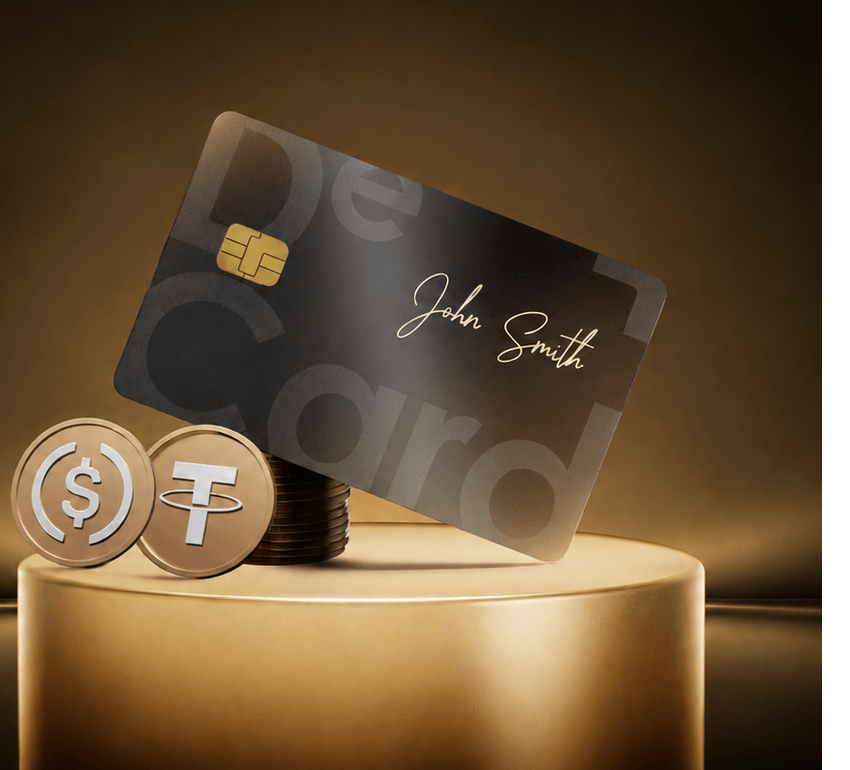
Sign up for DeCard with referral code QUIDS1 and you get a $5 reward once you transfer $50 or more to the card within 30 days of registration. DeCard is a Visa credit card from DCS Card Centre, a MAS-licensed credit card issuer, for spending USDC/USDT stablecoins: you prepay a starting limit, and unpaid balances cost 28% a year.
Requirement: Transfer $50 or more to the card within 30 days of registration
Medium10-15 minutes plus KYCPayout Credited to your account on the 10th of the following month
Verified 24 October 2026
Full claim instructions are on the DeCard offer page.
What DeCard is
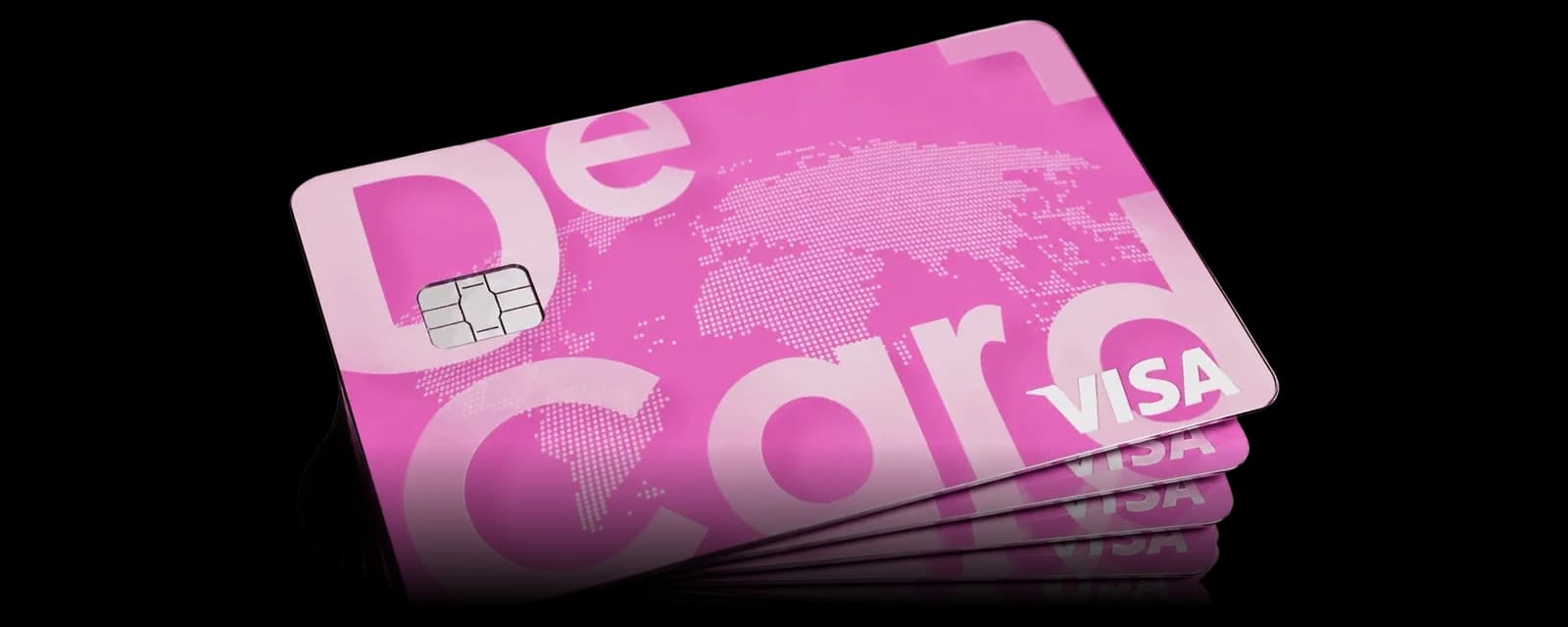
DeCard is the stablecoin card brand of DCS Card Centre Pte. Ltd., the Singapore company that began as Diners Club Singapore more than 50 years ago. DCS appears on the Monetary Authority of Singapore's register as a credit and charge card licensee, and DeCard replaced its earlier D-Lite card. The card runs on Visa, so it works online, in shops, through Apple Pay and Google Pay, and with QR scan-and-pay where offered.
It is a credit card rather than a debit card. Once approved you get a virtual card with a starting credit limit set by DCS, and you raise your spending power by paying to the card in advance with cash or stablecoins. DCS is a card issuer, not a bank, so money you pay to the card sits as a card balance rather than an insured bank deposit.
How topping up with stablecoins works
On the D-Vault page you choose Pay to card, pick USDC or USDT and a network, and DeCard gives you a unique deposit address. USDT works on Ethereum, Solana, Polygon, Arbitrum, BNB Smart Chain and Morph; USDC works on the same networks plus Base. Fireblocks converts the stablecoins at the real-time rate once the transfer is detected and credits the result to the card; DeCard asks you to contact support if it hasn't arrived within 30 minutes. Your first transfer asks for some personal details for compliance.
You choose a billing currency when you apply. The SGD card converts top-ups into Singapore dollars; the USD card converts them into US dollars and charges no FX fee on US-dollar transactions. Both earn 1 DePoint per US$1 spent. If you mostly pay in a third currency, such as yen or ringgit, either card charges the same 1.8% FX fee.
Who can apply
DeCard is available to individuals living in Singapore, Australia, Japan, South Korea, Malaysia, the Philippines, Taiwan, Thailand and Vietnam. You must be 18 to 70, and there is no minimum income. The US, the UK and the EU aren't on the list, and nationality doesn't matter: residence does.
Singapore citizens and permanent residents verify with Singpass. Everyone else uploads a passport and proof of address, then confirms personal, residence and employment details before submitting. A physical card typically arrives within two to four weeks of ordering, depending on the address.
Fees and limits
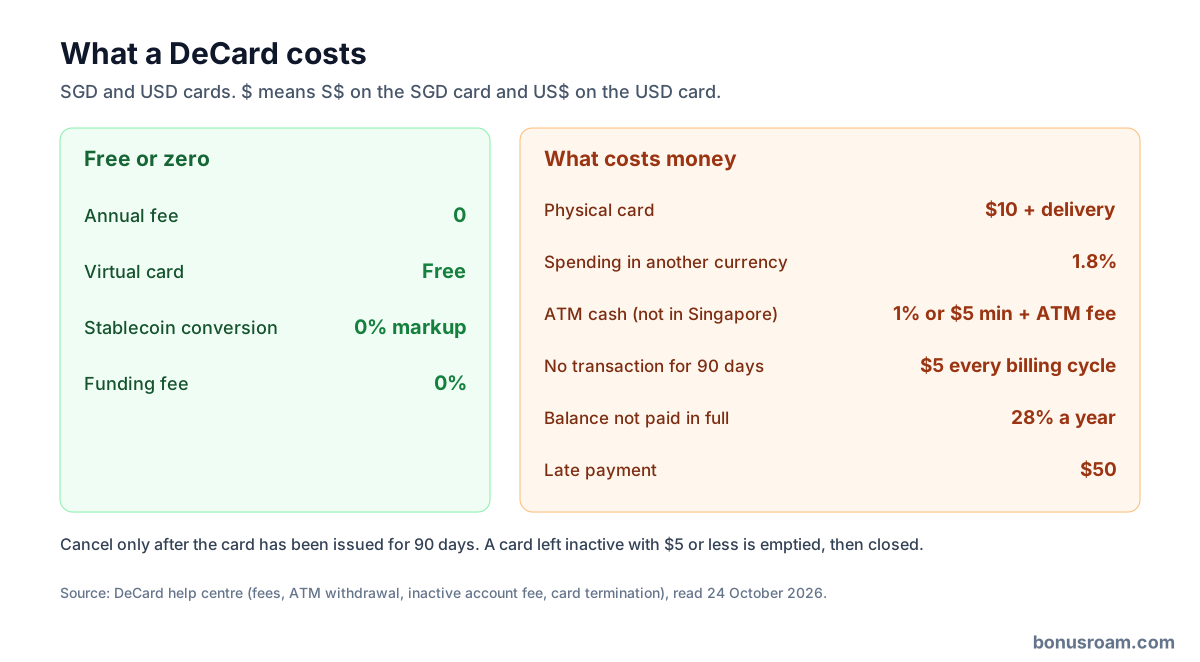
The SGD and USD cards have no annual fee, and the virtual card is free. A physical card costs S$10 or US$10 plus a delivery fee that depends on the market and shows in the app. Stablecoin conversion has 0% markup and funding is free. Transactions in any currency other than the card's billing currency cost 1.8%. Cash from an ATM costs 1% or $5, whichever is greater, plus the ATM operator's charge; withdrawals are capped at $3,000 a time, $10,000 a day and $100,000 a month, and the app says ATM cash works internationally but not in Singapore.
Two charges catch people out. If no transaction you started has gone through for 90 consecutive days, DCS charges S$5 or US$5 per card each billing cycle, a fee in force since 13 February 2026. And because it is a credit card, any balance you spend beyond what you prepaid and don't clear by the due date costs 28% a year, with a US$50 or S$50 late payment charge if the minimum isn't paid.
The referral: US$5 for a US$50 transfer
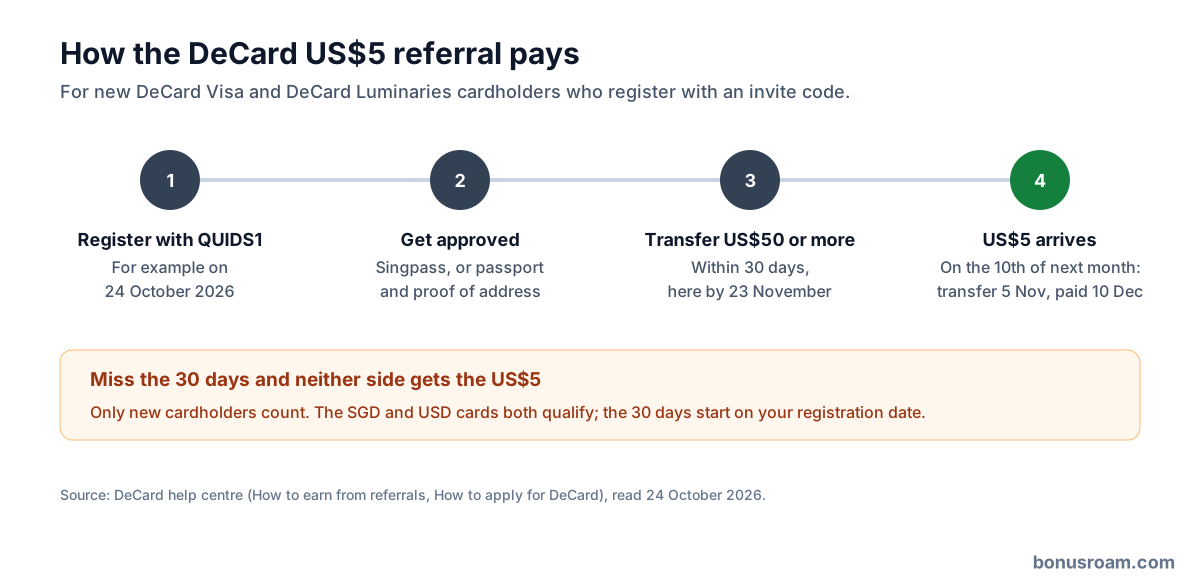
DeCard's referral terms are short. You must be a new DeCard Visa or DeCard Luminaries cardholder who registers with an invite code, and you must transfer at least US$50 to the card within 30 days of registering. When that is done, US$5 is credited to your account on the 10th day of the following month. If the transfer isn't made in time, neither side gets anything. The SGD and USD cards both count.
In practice: register on 24 October 2026 and the transfer must land by 23 November. Transfer on 5 November and the US$5 arrives on 10 December. Stablecoins are the cheap way to make the transfer, since the conversion carries no markup and there is no funding fee.
How to claim it
Open our DeCard sign-up link on this page so QUIDS1 is attached, or enter QUIDS1 when registration asks for an invite code. Create the account, go to the Card page, choose the SGD or USD card and complete verification. Once approved, open D-Vault, tap Pay to card and send at least US$50 within 30 days of the day you registered. Keep a note of the registration date and the transfer.
Disclosure: QUIDS1 is our own referral code, so we receive US$5 too when you qualify. It doesn't change your reward or your fees.
What it's worth
Take someone in Malaysia with 50 USDC who picks the USD card and the free virtual card. Sending the USDC on Polygon costs a small network fee, and the card shows about US$50 of spending power with no conversion markup. Spending it in ringgit costs 1.8%, or US$0.90, and the US$5 referral arrives the following month: about US$4 ahead, plus a card that turns stablecoins into everyday spending without an exchange withdrawal.
The numbers turn if you order the physical card for the reward alone, because S$10 or US$10 plus delivery is more than the US$5. They also turn if the card then sits unused: after 90 days without a transaction, the US$5 inactivity charge takes back the reward in a single billing cycle.
The catches
The inactivity fee is the big one. It is charged per card, every billing cycle, once 90 days pass without a transaction you started. If the balance is S$5 or US$5 or less, DCS takes what is left, and if the card is still inactive the following month it closes the card; a card with a zero balance and 90 days of inactivity closes straight away. You can only ask to cancel once the card has been issued for 90 days, through live chat in the app.
Spending beyond what you prepaid is borrowing at 28% a year, so treat the credit limit as a buffer, not money to use. And send only on a network DeCard lists for that coin: a transfer on any other network may never arrive.
DePoints and DeCard Luminaries
Every DeCard earns 1 DePoint per US$1 spent, ignoring cents. Points are valid for two years and can be redeemed in the app's catalogue for perks, discounts and partner offers.
DeCard Luminaries is the premium version: a metal card with a US$388 annual fee that can't be waived, 0% FX fees since 13 July 2026, cashback of up to US$200 a month, two DragonPass lounge visits and travel accident cover of up to US$1 million. It is aimed at founders, executives, Web3 creators and top DeCard spenders, for ages 21 to 65, and the referral bonus applies to it too. For most people the free card is the sensible start.
What users complain about
On 24 October 2026 the DCS DeCard app was rated 4.1 from 17 ratings on the Singapore App Store and 3.0 from 115 reviews on Google Play, where it has more than 10,000 downloads. That is a small sample, so read the themes rather than the averages.
The negative reviews describe accounts frozen after a first deposit flagged as coming from a third party, slow support, and an app that won't let you close the account yourself while the inactivity fee keeps running. The positive ones praise fast onboarding and painless USDC conversion.
Who should get it, and who should skip it
Get it if you live in one of the nine countries, already hold USDC or USDT, and will spend from the card at least every few weeks. The free virtual card with Apple Pay or Google Pay is enough for most people, and the USD card is the better pick if much of your spending is in US dollars.
Skip it if you only want the US$5, if you won't touch the card for months, if most of your spending is in a currency where the 1.8% fee adds up, or if you might spend beyond your prepaid balance and pay 28% interest. Residents outside the nine countries can't apply at all.
FAQ
- What DeCard referral code should I use?
- Use QUIDS1, either through our sign-up link on this page or by entering it when registration asks for an invite code.
- How do I get the US$5?
- Register as a new DeCard user with QUIDS1, get approved and transfer at least US$50 to the card within 30 days of registering.
- When is the US$5 paid?
- On the 10th day of the month after you meet the condition. A transfer on 5 November pays on 10 December.
- Which countries can apply?
- Singapore, Australia, Japan, South Korea, Malaysia, the Philippines, Taiwan, Thailand and Vietnam. Residence decides, not nationality.
- Is DeCard a debit card?
- No. It is a DCS Visa credit card with a starting credit limit, which you top up in advance with cash or stablecoins. Spending beyond your prepaid balance and not repaying it costs 28% a year.
- Which stablecoins and networks can I send?
- USDT on Ethereum, Solana, Polygon, Arbitrum, BNB Smart Chain and Morph, and USDC on the same networks plus Base.
- What fees should I watch?
- 1.8% on spending outside the card's billing currency, S$10 or US$10 for a physical card, ATM cash at 1% or $5 minimum, and S$5 or US$5 each billing cycle after 90 days without a transaction.
- Can I cancel straight away?
- No. DeCard lets you cancel once the card has been issued for 90 days, through live chat in the app.