


Rail International Review: Country Rules, Cross-Currency Costs and Virtual-Card Limits
Who can get a Rail card across 180+ countries, why Premium beats First class for foreign-currency spending, and the real travel catches from Apple Pay reach to 45-day card blocks.
Last updated 25 November 2026

Rail
Ad / referral links — we may earn a bonus when you sign up.
Full details & steps →Best for
Expats, digital nomads and cross-border crypto spenders outside Rail's 32 excluded territories who want high-limit virtual card spending with Apple Pay and Google Pay without upfront KYC, and can verify the live issuer terms before paying.
Start with geography and currency maths, not headlines. Rail is opening a waitlist for two virtual prepaid crypto cards aimed at 180+ countries — open across the EEA, UK, Canada, Australia, Singapore and (for Premium only) the United States, while excluding 31 listed countries plus Hong Kong from both tiers. There is no welcome bonus or spending cashback on our invite link. For anyone spending in euros, yen, pounds or other non-USD currencies, Premium's 0.5% FX fee and US$85 Year-1 fixed cost easily outperform First class's 2–2.5% FX fee and US$160 fixed cost; First class only pulls ahead on heavy USD-only spending above US$15,000 a year. Weigh those numbers against virtual-only limits (no ATM cash, 101-country Apple Pay reach, merchant pre-auth holds), a 45-day dormancy block clause and unnamed corporate and card-issuing partners.
Pros
- Broad international footprint across 180+ markets, including EEA, UK, Canada, Australia, Singapore and US access on Premium
- Premium's 0.5% FX fee on non-USD spending undercuts First class (2–2.5%) and typical 2.6%–12% dynamic currency conversion markups
- Direct top-ups from 8 crypto assets across 11 blockchains (including Solana, Tron, Ethereum, Base, Arbitrum, Polygon, TON and Bitcoin) from US$10
- High single-payment and daily limits (US$30k–US$80k per transaction; US$180k–US$1M daily) with Apple Pay and Google Pay tap-to-pay
- Free 1-minute waitlist signup lets you inspect launch terms before paying any issuance fee
Watch-outs
- No welcome bonus, no issuance discount and 0% cashback — top-up fees alone run 3.5%–4% off sent funds (3.63%–4.17% of spendable balance)
- Completely unavailable to residents, citizens, tax residents or visitors in Hong Kong and 31 other countries; First class also bars the US, China, India, Indonesia, Turkey, Ukraine, Bangladesh, Morocco and Nepal
- Virtual cards only with no ATM withdrawals and no physical card launch date, leaving cash-reliant destinations uncovered
- Apple Pay works in 101 countries and regions versus Rail's 180+ footprint, and hotel, fuel and car-rental holds freeze prepaid funds
- Terms omit the registered company name, address, card network and licensed card issuer, and carry no domestic deposit insurance
- Internal conflicts between rail.gg/fees (2–2.5% First class FX, no per-payment fee listed) and Rail's 15 Nov 2026 blog (1.5% FX, $0.30/$0.10 per payment)
Current related offer
Rail offer pageAd / referral links — we may earn a bonus when you sign up.
Provider
Rail
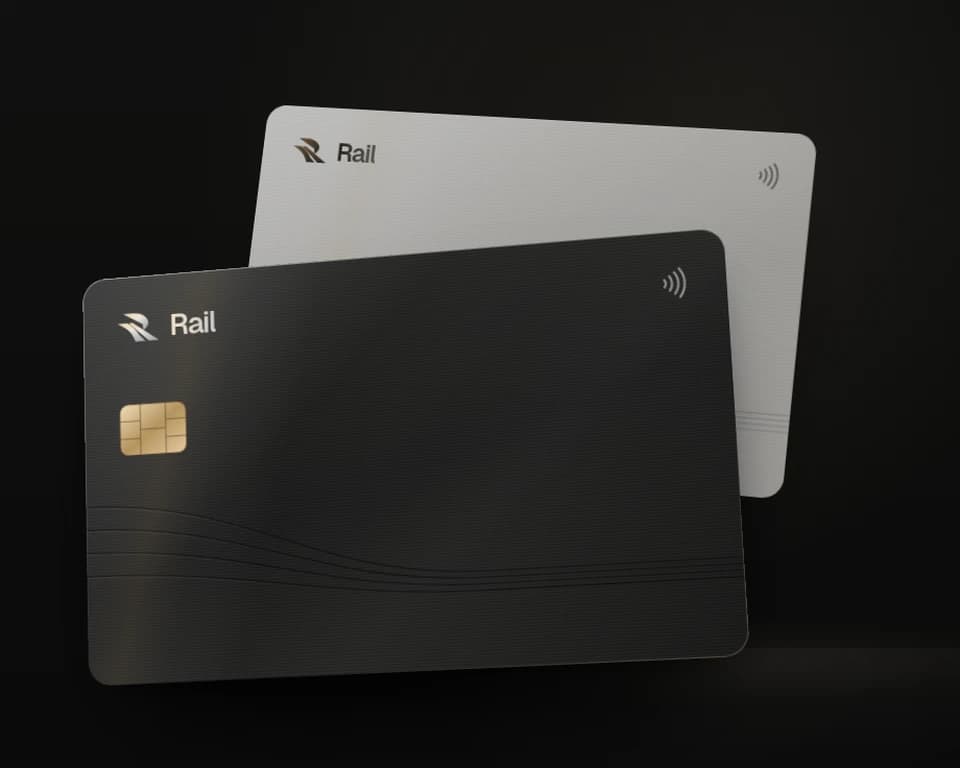
Join the Rail waitlist through our invite link to hear when its two virtual crypto cards launch across 180+ countries. Open in the US, Europe, Canada, Australia and Singapore — though Hong Kong and 31 countries are excluded — with no sign-up bonus or cashback and clear upfront fixed and FX trade-offs to weigh before funding.
Requirement: US$0 to join the waitlist; published launch pricing is US$25 issuance + US$5/month + 4% top-up + 0.5% FX on Premium, or US$40 + US$10/month + 3.5% top-up + 2–2.5% FX on First class (US$10 minimum top-up)
EasyAbout 1 minute to submit your email for the waitlist; launch timing is not yet announcedPayout Waitlist access only: Rail publishes no welcome cash bonus, issuance discount or cashback on spending
Verified 25 November 2026
Full claim instructions are on the Rail offer page.
Who can claim Rail — and where borders shut it off
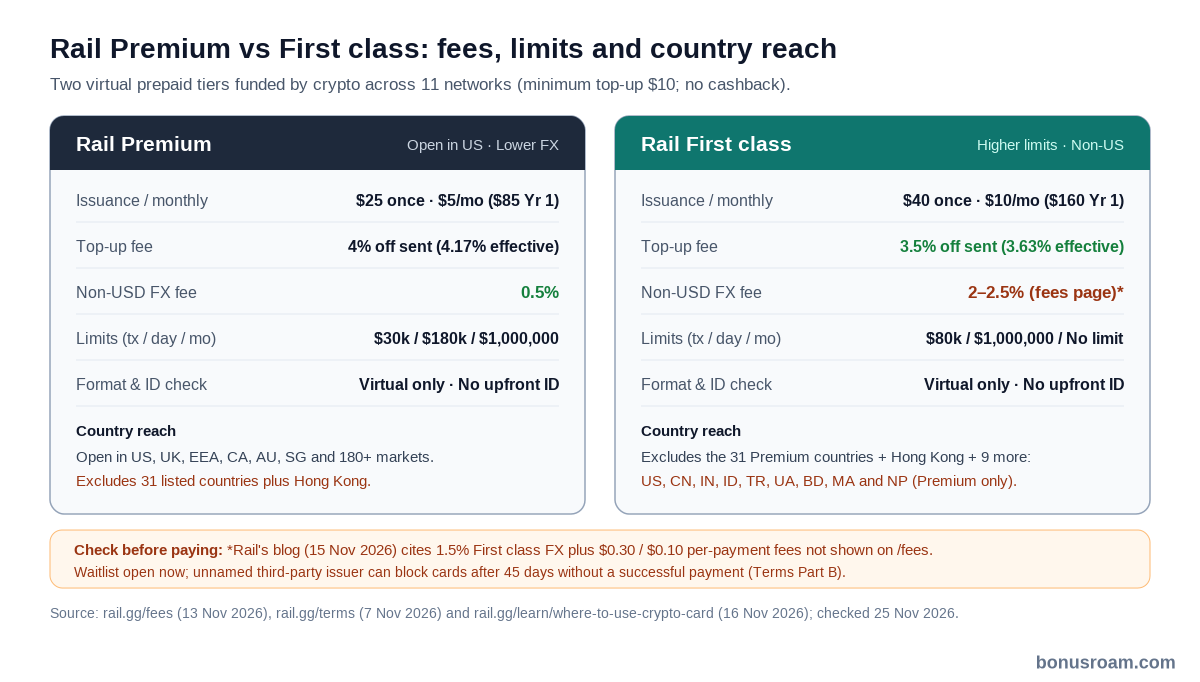
Eligibility comes before fees for international readers. Rail's 16 November 2026 country guide bars Premium in 31 listed countries (Afghanistan, Belarus, Bosnia and Herzegovina, Burundi, Central African Republic, Cuba, DR Congo, Ethiopia, Guinea, Guinea-Bissau, Haiti, Iran, Iraq, Lebanon, Liberia, Libya, Mali, Montenegro, Myanmar, Nicaragua, Niger, North Korea, Russia, Sierra Leone, Somalia, South Sudan, Sudan, Syria, Venezuela, Yemen and Zimbabwe) and explicitly places Hong Kong outside both tiers for anyone located in, resident in, a citizen of or tax resident of Hong Kong.
First class adds 9 more exclusions: Bangladesh, China, India, Indonesia, Morocco, Nepal, Turkey, Ukraine and the United States (making Premium the sole tier in those 9 markets). Crucially for travellers, Terms Part A §3.5(c) restricts providing services to anyone physically located in an excluded jurisdiction — so crossing into an excluded country on a trip puts you outside permitted use even if you live in Europe or North America.
Costs across currencies: why Premium beats First class abroad
Rail cards settle from a US-dollar balance converted at top-up. Under rail.gg/fees (13 November 2026), Premium charges US$25 once, US$5/month (US$85 Year 1), a 4% top-up fee and a 0.5% foreign-currency FX fee; First class charges US$40 once, US$10/month (US$160 Year 1), a 3.5% top-up fee and a 2–2.5% FX fee. Because top-up fees come off the amount sent, landing US$1,000 costs US$41.67 on Premium (4.17% of spendable funds) or US$36.27 on First class (3.63%), plus blockchain gas or exchange withdrawal fees.
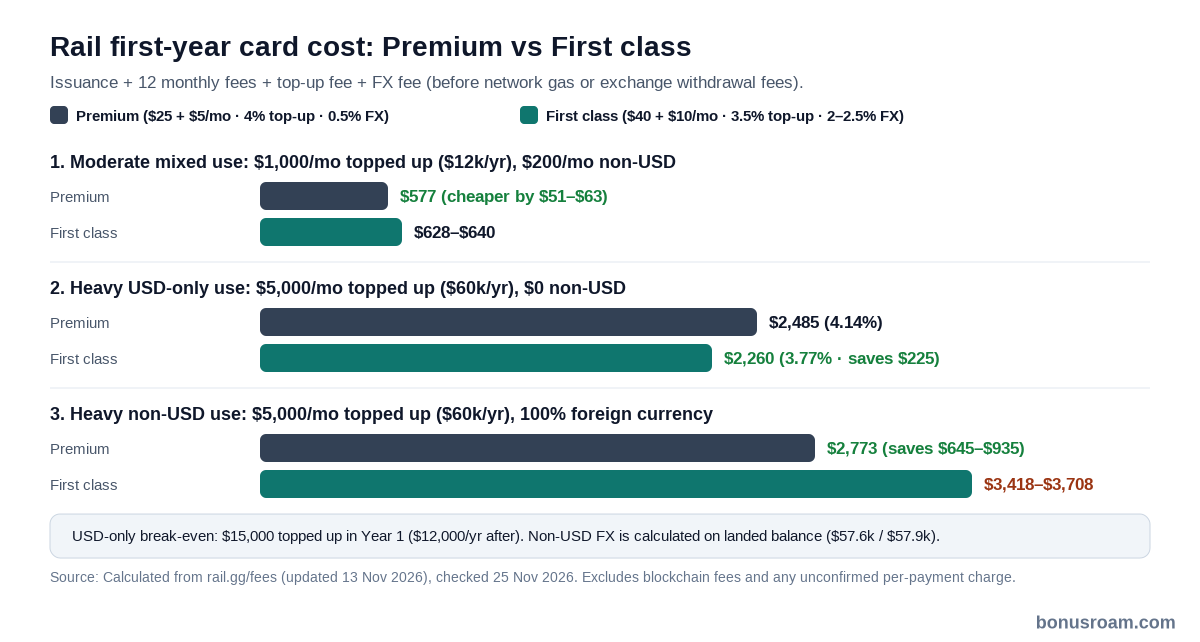
That FX split flips the tier choice for expats and travellers spending outside the US dollar. On US$1,000/month topped up with US$200/month spent in euros or yen, Premium costs US$577 in Year 1 versus US$628–US$640 on First class. Scale that to US$5,000/month (US$60,000/year) spent entirely in foreign currencies and Premium costs US$2,773 against US$3,418–US$3,708 on First class — saving US$645–US$935 a year. First class wins only on heavy US-dollar spending above US$15,000 in Year 1 (US$12,000/year after): at US$60,000/year in USD, First class costs US$2,260 versus US$2,485 on Premium.
Travel reality: phone wallets, cash gaps and merchant holds
Both Rail tiers launch as virtual cards only (3-year validity), meaning in-person payments rely entirely on Apple Pay or Google Pay at contactless terminals. Apple lists 101 countries and regions for Apple Pay — well short of Rail's 180+ coverage — and Rail's fee page lists zero ATM cash withdrawals. Until a physical card actually launches (no date or fee announced), anyone travelling to cash-first economies or places with older chip-only terminals needs a separate bank card.
Prepaid mechanics also show up at checkout. Hotels, fuel pumps (up to US$175 holds in the US) and rental desks place pre-authorisation holds that freeze your deposited balance for up to a week; major car-rental policies such as Hertz's allow prepaid cards only at the end of a rental, not to qualify at pickup. Always decline dynamic currency conversion prompts abroad and pay in local currency.
Multi-chain funding: 8 assets and 11 networks to verify
Rail's core convenience pitch is letting remote workers paid in stablecoins top up directly without bridging. Its Learn guides list 8 assets across 11 networks from a US$10 minimum: USDC (Arc, Solana, Ethereum, Polygon), USDT (Tron, Ethereum, Solana, TON), USDG (Ethereum, Solana, Robinhood Chain, Arbitrum), ETH (Ethereum, Robinhood Chain, Base), BTC, SOL, POL and BNB. Moving USDC on Solana or USDT on Tron keeps network gas minimal compared with Ethereum mainnet.
Double-check the live funding screen once cards launch, because Rail's homepage selector lists 7 assets (omitting BTC, TON, Arc and Arbitrum while showing Base USDC and BNB Chain USDT). Sending tokens over an unsupported chain can cause irreversible loss (Terms Part D §D.4).
Using our waitlist invite link
Start through our Rail invite link in one browser session so the referral cookie attaches before you enter your email in the Get Rail waitlist modal. Rail publishes no welcome cash bonus, free card issuance or spending cashback for invited users; our link simply registers you cleanly for launch updates.
Because the waitlist form has no manual code box, avoid switching browsers or clearing cookies before submitting your email.
Fine print and fee contradictions to check before paying
Before paying the non-refundable US$25 or US$40 issuance fee at launch (Terms §7.3), reconcile two discrepancies inside Rail's own site: rail.gg/fees (13 November 2026) cites 2–2.5% FX on First class with no per-payment fee, whereas Rail's 15 November 2026 comparison guide cites 1.5% FX in its summary table (2% in an example) plus US$0.30/US$0.10 per-payment charges. The live transaction Confirmation prevails under Terms §2.3.
Watch the 45-day dormancy rule too: keeping a virtual Rail card purely as a spare travel card risks temporary or irreversible blocking if more than 45 continuous calendar days pass without a successful payment (§B.9.3), while active cards still incur US$5 or US$10 monthly fees. Depositing US$2,000+ and moving funds out within 48 hours also triggers a risk review with up to 10% withholding if a breach causing costs or losses is established (§10.3.2–10.3.6).
Custody, corporate opacity and deposit protection
Rail is a custodial prepaid product, not a bank. Top-ups go into third-party Custodian Wallets and appear in a USD Virtual Account accounting ledger that pays zero interest and carries no European DGS, US FDIC, UK FSCS or domestic deposit insurance. Even more importantly, neither the Terms of Use nor the Privacy Policy (both dated 7 November 2026) identifies the legal company name, incorporation jurisdiction, registered office, card network, licensed card issuer or custodian.
Governing law is Hong Kong with HKIAC arbitration in English (subject to mandatory consumer-court rights in your country of habitual residence under §23.4). Because Rail is still on a waitlist with no App Store or Google Play listings and only 494 subscribers on @raildotgg as of 25 November 2026, this review relies on official disclosures rather than funded travel testing.
Decision guide: keep Rail on your radar or skip it
Join the free waitlist if you live in an eligible country (especially the US or an EEA/APAC market outside Hong Kong), value high virtual-card limits and phone-wallet spending without an upfront ID check, and intend to verify the final fee table and named card issuer before depositing a dollar.
Skip it if you are looking for a welcome bonus or cashback, reside in or travel frequently to Hong Kong or another excluded country, need physical ATM access abroad, or already qualify for lower-cost 0%–1% international crypto or multi-currency bank cards.
FAQ
- Which countries can get Rail Premium versus First class?
- Both tiers exclude 31 listed countries (including Russia, Iran, North Korea, Cuba, Venezuela and Belarus) plus Hong Kong. First class excludes 9 additional countries: the US, China, India, Indonesia, Turkey, Ukraine, Bangladesh, Morocco and Nepal — leaving Premium as the only tier there.
- Is Premium or First class cheaper for international non-USD spending?
- Under rail.gg/fees (13 November 2026), Premium is cheaper for almost all foreign-currency spend because its 0.5% FX fee and US$85 Year-1 fixed cost undercut First class's 2–2.5% FX fee and US$160 fixed cost. First class only wins on heavy USD-only spend above US$15,000 in Year 1.
- Can I use a Rail card while visiting Hong Kong or another excluded country?
- No. Rail's guide explicitly excludes anyone located in Hong Kong, and Terms Part A §3.5(c) bars providing services to anyone located in an excluded or sanctioned jurisdiction, regardless of where you normally reside.
- Does Rail work for ATM withdrawals, hotel deposits or car rentals?
- No ATM withdrawals are supported because both tiers are virtual-only today. Hotels and fuel pumps place pre-authorisation holds that lock prepaid funds, and major rental desks such as Hertz do not accept prepaid cards to qualify at pickup.
- Does joining through our link include a sign-up bonus or lower fees?
- No welcome cash bonus, issuance discount or spending cashback is published for invited users. Our link registers your email on the launch waitlist cleanly.
- What happens if I leave a Rail card unused between trips?
- Terms Part B §B.9.3 lets the card issuer temporarily or permanently block any card with no successful payment for more than 45 continuous calendar days — potentially irreversibly — while monthly fees apply to active cards.
- Are Rail balances covered by bank deposit insurance?
- No. Balances sit in a custodial virtual ledger managed through unnamed third-party custodians and issuers, with no FDIC, EU DGS, FSCS or other statutory deposit guarantee.
Related offers

Provider
Plasma One
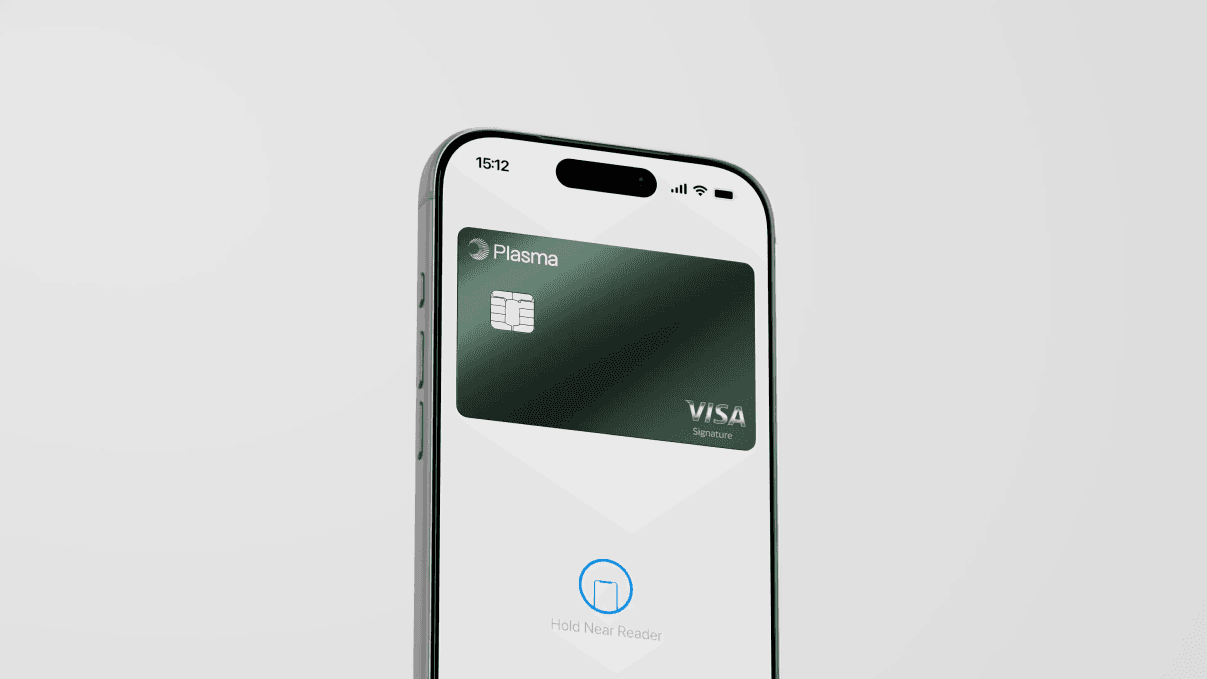
For residents outside Plasma's 30 blocked and restricted countries who can pass Sumsub checks on iOS or Android. Under the 11 November 2026 tiers, Standard has a $0 annual fee ($10 spendable deposit or regional card fee in most regions), pays 1% on the first $500 a month (0.1% after) and charges a 1% total FX fee on non-USD purchases. Premium ($600/year) waives FX up to $3,000/month and includes $200/year AI credit; Platinum ($2,500/year) waives FX worldwide and adds lounges plus airline/wellness credits. Code GQUIDS gives immediate access and $10/$200 Spending Credit Spend Bonuses.
Requirement: No annual fee on Standard ($10 spendable deposit or regional card fee in most regions). GQUIDS Spend Bonuses unlock at $100 across 2+ merchants in 14 days ($10) and $10,000 in 60 days ($200); Nigeria, Bangladesh and Kenya IDs excluded
Medium10–20 minutes on your phone to install, pass checks and activate a virtual cardPayout Base cashback pays Thursdays in XPL; category credits and Spend Bonuses arrive as Spending Credit.
Verified 22 November 2026

Provider
Krak
Who can claim it: anyone who lives in a country Kraken serves other than the UK, Singapore, Austria or Turkey and has never held or registered a Krak or Kraken account; the country you live in now decides which invite applies. Outside the EEA, verify to Intermediate, top up the equivalent of US$10 in cash rather than crypto and send money as the app asks, for US$2 or more within 30 days of Krak confirming you qualify (our invite page shows US$10); in the US the top-up is free by ACH or US$0.63 by debit card. In the EEA the invite is a card reward in euros: order the physical card and make the purchases the app shows within 90 days. Either way you get one account for six currencies, free Kraktag transfers and no transfer fee to more than 160 countries, though not a bank account.
Requirement: Depends on where you live: outside the EEA, a cash top-up worth US$10 and the transfer the app asks for; in the EEA, the physical card and the purchases the app shows within 90 days
MediumAbout 10–15 minutes to register and verify on your phone; the EEA card invite gives you up to 90 days for the purchasesPayout Outside the EEA: within 30 days of Krak confirming you qualify. In the EEA: in euros, within 14 days of the last qualifying step
Verified 24 October 2026

Provider
Startale
Virtual Startale Visa cards (issued by Third National with Rain) began rolling out in priority rank batches on 2 November 2026. If not yet invited, anyone 18+ with an email reserves free through our link with KNEJGM36 — $0 deposit, no KYC, no joining bonus. Invited users clear 5-minute Rain KYC, fund strictly with USDSC via Default Card Balance, add manually to Apple Wallet or Google Wallet, and earn 1% settled USDSC cashback (0% APR). Note that International Card Terms list up to 1.5% non-USD FX and up to 1.5% cross-border fees, exceeding 1% cashback abroad.
Requirement: $0 to reserve a queue spot; USDSC top-up needed once invited to activate
EasyAbout 5 minutes in a browser to reserve; about 5 minutes to apply once invitedPayout No joining payout; queue rank updates daily and approved cards pay 1% USDSC cashback upon transaction settlement
Verified 20 November 2026